Gentle Parenting for Strong-Willed Kids: When Empathy Meets Solid Boundaries
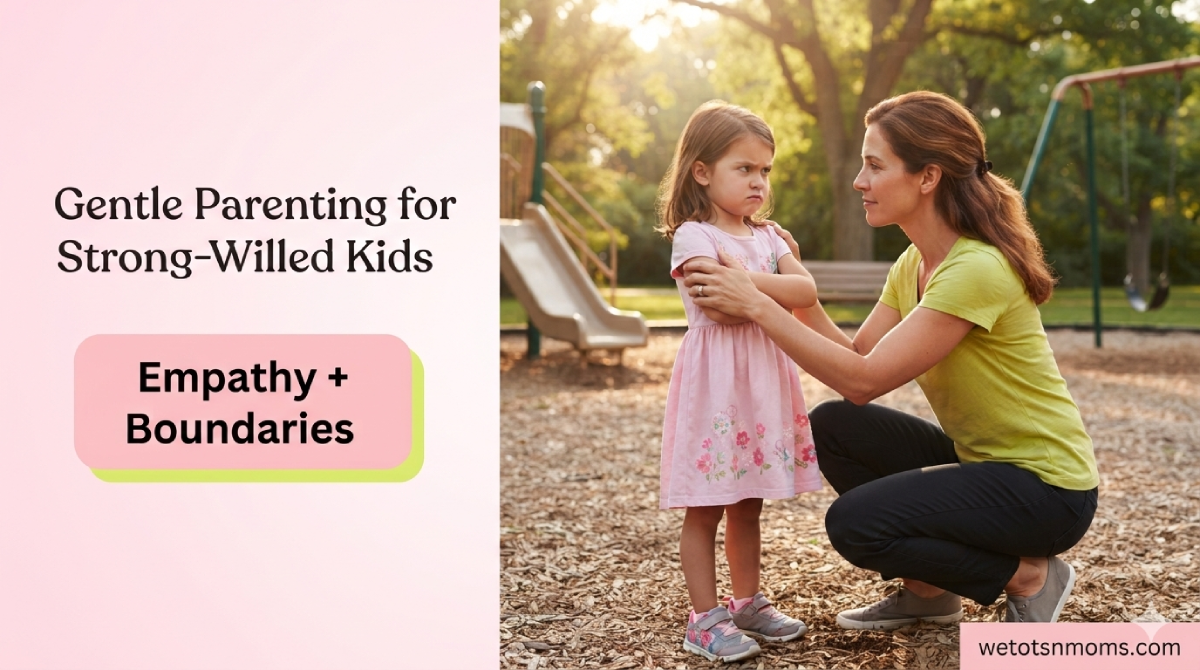
If you are raising a strong-willed child, you already know that standard gentle parenting scripts often fall completely flat. You have likely tried the soft, validating whispers recommended online, only to be met with a toy thrown at your head or a defiant scream of "No! You can't make me!" This intense defiance leaves parents feeling exhausted, deeply depleted, and riddled with guilt, wondering if gentle parenting is a flawed philosophy.
The truth is that positive parenting is not broken, but our implementation is.
True positive parenting is authoritative parenting, which combines high warmth with clear, unyielding boundaries. For a strong-willed child, kindness without firmness is a recipe for family chaos. To make gentle parenting work, you must understand the neurobiology of defiance and learn how to pair empathy with solid, non-negotiable limits.
Part 1: The Biology of the Strong-Willed Child
To parent a strong-willed child effectively, we must understand their unique wiring. Driven by biology to test boundaries with intense focus, these children act like "little scientists," pushing and testing every limit in their environment to see what holds under pressure.
When faced with constant testing, permissive parenting becomes a dangerous trap. Fearing a tantrum, permissive parents negotiate, bend rules, or walk back boundaries to keep the peace.
While done out of love, it backfires. Research on parenting styles has generally found that children benefit from a combination of warmth and consistent expectations. High warmth without clear limits can sometimes make it harder for children to build frustration tolerance and self-regulation skills.
A world without firm walls feels terrifyingly unpredictable. If the adult in the room refuses to hold a firm line, the child’s nervous system perceives that the caregiver is not strong enough to protect them from their own intense impulses. Boundaries are the literal perimeter of safety that a strong-willed child desperately needs to relax.
"Strong-willed children do not need stronger punishments. They need stronger leadership delivered with calm confidence."
Part 2: The Three-Step Sequence for Defiance
A practical roadmap for handling power struggles without becoming permissive or authoritarian.
When a child is in the middle of a blowout, trying to lecture, explain, or reason with them is a biological impossibility. Their stress cup has overflowed, triggering an amygdala hijack that shuts down their logical prefrontal cortex. To reclaim control calmly, you must follow the precise biological sequence: Regulate, Connect, and Correct.
Step 1: Regulate Yourself First
Children borrow our nervous system before they borrow our logic.
Children possess hyperactive mirror neurons that constantly scan your nervous system. If your heart is racing and your jaw is clenched, their biology registers you as a threat.
-
The TRACE Method: To ride out the ninety-second stress-hormone wave, practice TRACE:
- Trigger: Notice tightening in your chest or jaw.
- Respiration: Slow your breathing to trigger your vagus nerve.
- Awareness: Locate physical tension.
- Choose grounding: Press your feet firmly into the floor.
- Engage: Respond only after the ninety-second wave passes.
Step 2: Connect Before Correct
Validation lowers resistance and helps a child feel understood.
Lower your physical intensity and soften your posture. Sit nearby and say much less. Too many words add sensory overload to an already overloaded brain, worsening the meltdown. Use a brief grounding statement: "It is okay to feel angry, and I am right here." Your calm presence allows their nervous system to latch onto yours.
Step 3: Hold the Boundary
Empathy does not remove the limit.
Only when their nervous system settles and their thinking brain is back online can you move to correction. Unlike traditional parenting, which relies on fear-based punishments, authoritative parenting uses consequences that teach self-regulation and cause-and-effect.
Part 3: Reclaiming Action-Based Discipline
Mainstream gentle parenting often makes the critical mistake of rejecting consequences entirely. However, modifying defiance fundamentally requires action, not just words. For a strong-willed child, validation alone will not stop physical aggression. You must deploy consistent, evidence-based boundaries:
- Logical Consequences: These must be directly and intrinsically tied to the behavior. If your child throws a toy, the toy goes onto a high shelf. If they refuse to follow safety rules at the playground, you immediately leave.
- Planned Ignoring: For minor, attention-seeking behaviors like whining, withdraw your engagement completely. The exact millisecond they use a normal voice, flood them with positive attention. This teaches their brain what actually works.
- Timeouts Done Right: When safety is compromised, properly used timeouts act as a vital sensory reset. Research has found that calm, age-appropriate timeouts used as part of a warm parent-child relationship are generally not associated with the harms often claimed online. The key is using them as a brief reset rather than a punishment delivered in anger.
Part 4: Rupture, Repair, and Rebuilding Trust
Parenting a strong-willed child is exhausting, and your patience is a finite biological resource. You will eventually hit empty and lose your temper. True gentle parenting is not about being a perfect, emotionless robot. Once regulated, practice a clean, accountable repair:
"I am sorry I lost my temper and yelled. It was not fair to take my frustration out on you. Let's try again."
Apologize cleanly without making excuses. This teaches your child that relationships are resilient, conflict is survivable, and mistakes can be repaired.
Interactive Section: Test Your Style with a Defiant Scenario
Scenario: Your child refuses to put away their toys, looks you dead in the eye, and screams, "No! You can't make me!" How do you react?
- Option A: "You do what I say right now or I am throwing all of these toys in the trash! Go to your room!"
- Option B: "Oh sweetie, I know cleaning up is hard. How about you go play and I will clean them up for you this time?"
- Option C: Take a slow breath, crouch down, and say: "You are having so much fun and don't want to stop. It is okay to feel disappointed, but it is time to clean up. We can put them away together, or the toys will go in the basket for tomorrow."
Scoring Guide:
- Mostly A: The Traditional Authoritarian. Uses fear and threats, which stop the immediate behavior but breed resentment and fail to teach regulation.
- Mostly B: The Permissive Trap. Avoids immediate conflict but shields kids from frustration, robbing them of resilience and driving up anxiety.
- Mostly C: The Authoritative Sweet Spot. You validate disappointment while holding a firm, predictable limit. This is how gentle parenting actually raises capable, resilient adults.
For more science-backed parenting strategies and actionable resources to make your home a peaceful anchor, visit us at www.wetotsnmoms.com.
Strong-Willed Parenting Mastery Quiz
Test Your Understanding of Authoritative Discipline & TRACE Co-Regulation
Test your knowledge on handling defiance, the TRACE method, and authoritative boundaries with this quick 5-question interactive quiz!
Final Thoughts
Strong-willed children are often misunderstood. Their resistance is not always a sign of disrespect or poor behavior. More often, it is a reflection of a child with a powerful drive for autonomy, determination, and independent thinking.
The challenge is not breaking that spirit. The challenge is learning how to guide it. When parents rely on threats, arguments, or endless negotiations, power struggles tend to grow stronger. When parents combine empathy with calm, consistent leadership, cooperation becomes far more likely.
Remember the TRACE Method
Before responding to defiance: regulate your own emotions, tune into what your child is experiencing, acknowledge their feelings, communicate the boundary clearly, and enforce the limit consistently. Strong-willed children need connection, but they also need confident leadership.
Progress is not measured by instant obedience. It is measured by fewer power struggles, faster recovery after conflicts, growing self-control, and a relationship built on trust rather than fear.
A strong-willed child can become an incredibly resilient, courageous, and capable adult. With patience, empathy, and firm boundaries, you are not fighting their strength— you are teaching them how to use it wisely.
Gentle Parenting for Toddlers
Learn how to handle hitting, biting, tantrums, and emotional overload.
Is Gentle Parenting Effecttive
Explore what developmental psychology and research say about gentle parenting.
Gentle Parenting Morning Routine
Learn how to balance empathy with firm boundaries during defiance and power struggles.

About the Author: Rose Graham
Founder & Parent Educator
As the oldest of six children growing up in an impoverished home with uneducated parents, my early childhood was challenging, and at times, intensely difficult. Navigating those early years in a high-stress environment gave me a firsthand, unfiltered understanding of what happens to a child's emotional world when resource scarcity and survival take center stage. Later in life, watching close friends and relatives manage the intense isolation of single parenthood gave me a front-row seat to the crushing weight of modern parental burnout.
Those raw experiences lit a fire in me. I founded We Tots N Moms out of a deep personal mission to eliminate family burnout and help parents cultivate secure, deeply connected relationships with their children—no matter their background or economic status.
Blending decades of lived family experience with a deep study of early childhood development, family dynamics, and neurobiological parenting frameworks, I specialize in translating complex psychological concepts—like executive function and nervous system regulation—into highly practical, everyday scripts for busy caregivers. I intentionally focus on the unique struggles of single mothers, toddlers, and preschoolers, constantly researching data and developmental literature to address the most urgent, real-world questions parents are asking today.
I don't write from an ivory tower. I am right there with you in the parenting trenches every day, practicing and refining the exact empathetic, boundary-led co-regulation strategies shared across this platform.