wetotsnmoms Nurturing Peaceful Homes
Parenting Insights Updated September 2026

Common Gentle Parenting Mistakes: Why It Fails and How to Fix It

Modern parents face intense pressure to be calm, serene guides. But when real-life tantrums hit, soft whispers often fail. Here is why gentle parenting backfires—and how to fix it with authoritative firmness.

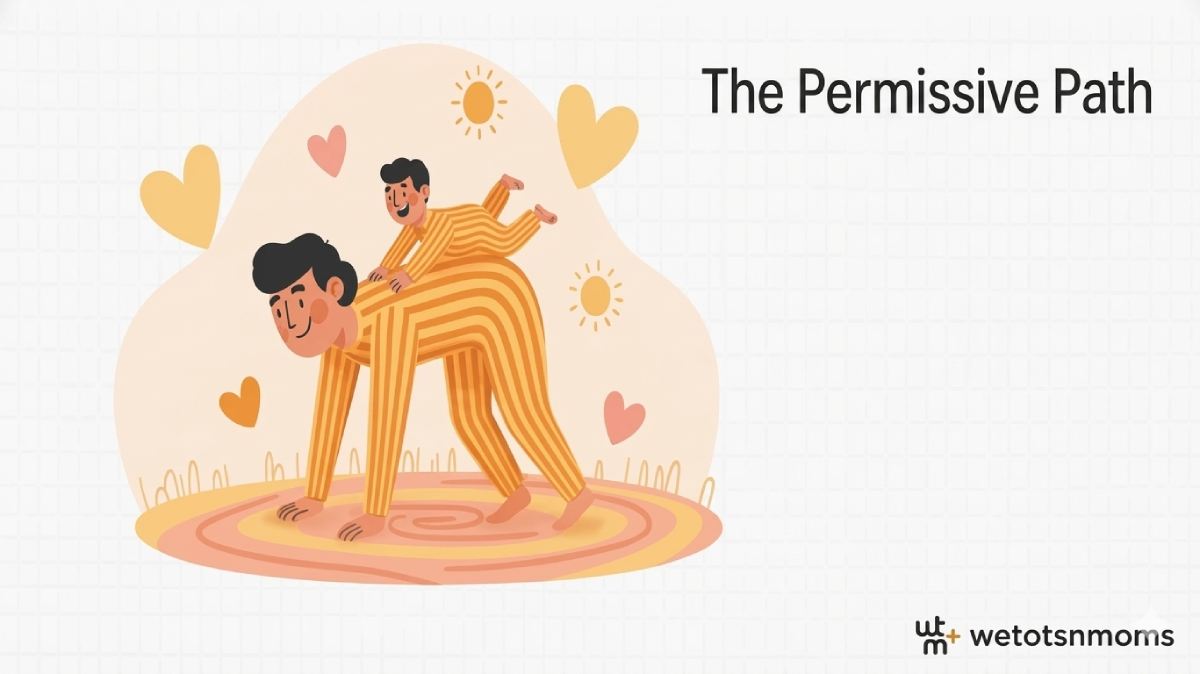
Father has his son on his back

Modern parents face intense pressure to be perfect, serene guides. Social media feeds display calm adults using soft whispers to resolve meltdowns. But in the real world, when a child throws dinner at the wall or screams during transitions, these scripts fail. This leaves parents exhausted, burned out, and drowning in guilt.

Behavioral science reveals that positive, evidence-based parenting is highly effective. However, popular interpretations often lead to common implementation mistakes. Understanding these errors helps you build a sustainable, peaceful home. Here are the four most common gentle parenting mistakes and how to fix them.


1

Mistake: The Permissive Slide (Dropping Boundaries)

The most common mistake is confusing "gentle" with "permissive." Clinical research defines permissive parenting as having high warmth but low expectations and boundaries. Fearing tantrums, permissive parents negotiate every rule, bend limits, and avoid conflict at all costs.

Why It Fails

Children are biologically driven to test boundaries. They act as "little scientists" searching for security. If you place a child in a room with no walls, they will run and push until they find an edge. Without clear limits, the world feels terrifyingly unpredictable. This lack of structure breeds entitlement, low frustration tolerance, and higher rates of anxiety.

The Fix: Authoritative Firmness

Adopt the authoritative style—the clinical gold standard. Pair high warmth with high expectations and firm, non-negotiable boundaries. Holding a boundary calmly with empathy, rather than intimidation, teaches children that you are strong enough to protect them from their own impulses.

2

Mistake: The Biological Blind Spot (Reasoning with an Offline Brain)

When a child is in the middle of a meltdown, parents often try to use logical scripts to talk them down. They explain, reason, and ask questions while the child is actively screaming.

Why It Fails

During a meltdown, a child's amygdala (the threat detector) takes over, triggering fight-or-flight. Their logical prefrontal cortex goes completely offline. Trying to reason with a screaming child is biologically impossible—like fixing a hardware crash by running a software update. Excess words add sensory overload.

The Fix: Connect & Regulate First

Stop talking. Lower your physical intensity, drop your shoulders, and soften your posture. Sit nearby to signal safety. Offer a simple grounding statement: "This feels hard, and I am right here." Let their mirror neurons latch onto your calm nervous system before trying to teach.

3

Mistake: Treating Patience as a Moral Virtue

Many parents treat patience as a personality trait—believing they are naturally patient or simply failing when they lose their temper.

Why It Fails

Patience is a finite biological and emotional supply, not a moral virtue. It is drained throughout the day by persistent hypervigilance and isolation. Snapping at day's end is not a character flaw, but a resource equation: your nervous system had zero recovery time.

The Fix: Protect Biological Maintenance

You cannot co-regulate a child on an empty system. Schedule a daily 45-minute block of zero responsibility. This biological requirement allows your body to flush ambient stress hormones and rebuild your patience baseline.

4

Mistake: Rejecting Consequences and Discipline

Fearing boundaries are punitive, some parents reject consequences entirely, relying solely on validation.

Why It Fails

All behavior has consequences; avoiding them robs children of emotional immunity. However, arbitrary punishments (like taking away screen time because a child hit a sibling) breed resentment and only teach children to be sneakier.

The Fix: Cause-and-Effect Consequences

Use natural and logical consequences directly tied to actions:
• Natural: Refusing a coat means feeling cold.
• Logical: Coloring on the wall means helping clean it.
• Timeouts Done Right: Short sensory resets to lower cortisol.

Interactive Check Self-Assessment

Diagnostic Quiz: What Is Your Parenting Style Trajectory?

Test your real-life responses against behavioral science principles to discover if you are falling into gentle parenting traps.

Question 1 of 4 Scenario 1

Your child is whining and clinging to your leg while you are trying to make dinner. How do you respond?

Final Thoughts

Gentle parenting does not fail because it is too soft. More often, it struggles because one of four common mistakes has quietly taken over:

  • 1. The Permissive Slide (Dropping Boundaries)
  • 2. The Biological Blind Spot (Reasoning with an Offline Brain)
  • 3. Treating Patience as a Moral Virtue Instead of a Resource
  • 4. Rejecting Consequences and Discipline Altogether

The good news is that these mistakes can be identified and corrected. Small adjustments in how you respond to your child's emotions, boundaries, and behavior often create meaningful changes over time.

If you are not seeing immediate results, do not assume the approach is failing. Emotional regulation, frustration tolerance, and cooperation develop gradually. Children learn through thousands of consistent interactions rather than a single parenting technique.

Revisit the Interactive Quiz

The quiz is designed to help you recognize patterns in your responses. Do you tend to react with control and frustration? Do you avoid conflict by giving in? Or are you balancing empathy with clear, consistent boundaries?

Decades of developmental research consistently point toward authoritative parenting—high warmth combined with clear boundaries—as the approach most strongly associated with healthy emotional development, resilience, and long-term self-regulation. Children need empathy. Children need boundaries. And they need adults who can provide both at the same time.

Related Articles

Gentle Parenting Series

Gentle Parenting for Toddlers

Learn how to handle hitting, biting, tantrums, and emotional overload.

Gentle Parenting Series

Is Gentle Parenting Effective?

Explore what developmental psychology and research say about gentle parenting.

Gentle Parenting Series

Gentle Parenting for Strong-Willed Kids

Learn how to balance empathy with firm boundaries during defiance and power struggles.

 author's bio image

About the Author: Rose Graham

Founder & Parent Educator

As the oldest of six children growing up in an impoverished home with uneducated parents, my early childhood was challenging, and at times, intensely difficult. Navigating those early years in a high-stress environment gave me a firsthand, unfiltered understanding of what happens to a child's emotional world when resource scarcity and survival take center stage. Later in life, watching close friends and relatives manage the intense isolation of single parenthood gave me a front-row seat to the crushing weight of modern parental burnout.

Those raw experiences lit a fire in me. I founded We Tots N Moms out of a deep personal mission to eliminate family burnout and help parents cultivate secure, deeply connected relationships with their children—no matter their background or economic status.

Blending decades of lived family experience with a deep study of early childhood development, family dynamics, and neurobiological parenting frameworks, I specialize in translating complex psychological concepts—like executive function and nervous system regulation—into highly practical, everyday scripts for busy caregivers. I intentionally focus on the unique struggles of single mothers, toddlers, and preschoolers, constantly researching data and developmental literature to address the most urgent, real-world questions parents are asking today.

I don't write from an ivory tower. I am right there with you in the parenting trenches every day, practicing and refining the exact empathetic, boundary-led co-regulation strategies shared across this platform.